Reporting & Reconciliation
Carabaas provides a single source of truth for digital asset financial data across all 60+ supported blockchains. Instead of aggregating data from chain-specific tools, node providers, and block explorers — every balance, transaction, and fee is available in one unified view, through the dashboard and the API.
Real-Time Positions
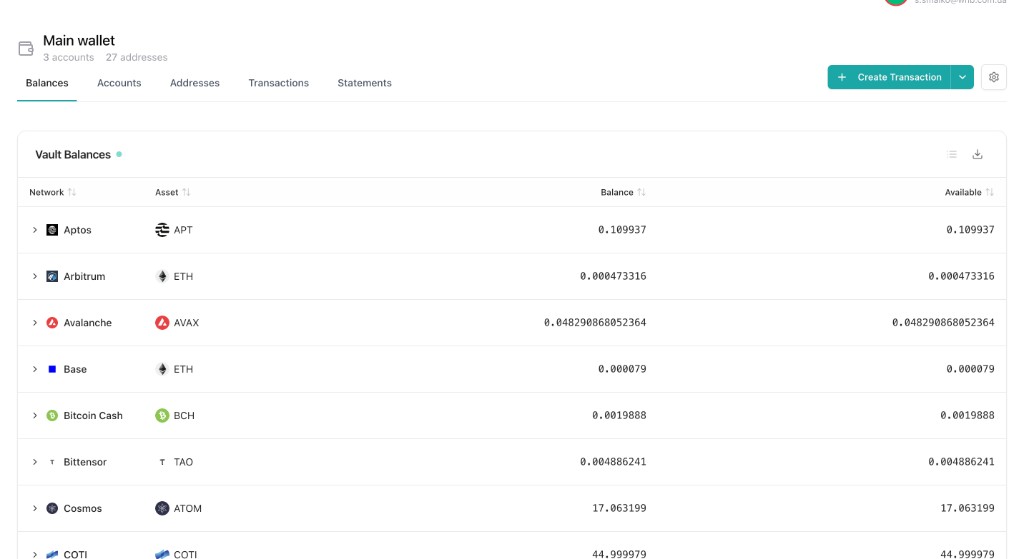
Every vault displays current balances per network and asset, updated in real time as transactions are confirmed on-chain.
Balances are available at three levels of granularity:
| Level | What It Shows |
|---|---|
| Vault | Aggregated positions across all accounts and addresses |
| Account | Balances within a specific organizational grouping |
| Address | Per-address balance for a single blockchain endpoint |
Each balance includes both the total balance and the available balance (total minus amounts reserved for pending outgoing transactions). This prevents overdrafts and gives operations teams accurate, real-time visibility into what can actually be moved.
Historical Statements
Generate balance statements for any date range — end-of-day, end-of-month, end-of-quarter, or any custom period. Not just the current state, but a full point-in-time snapshot of what was held on any date in the past.
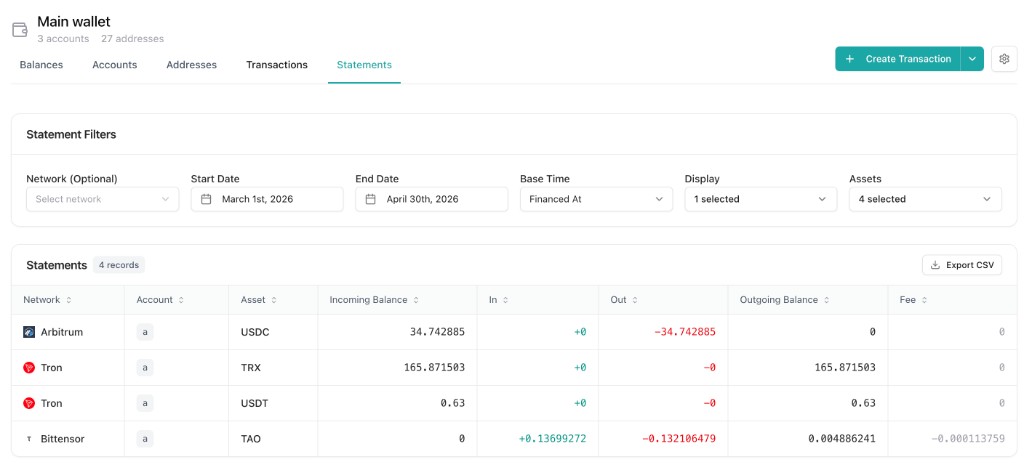
Each statement includes:
- Incoming balance — position at the start of the period
- In / Out — total deposits and withdrawals during the period
- Outgoing balance — position at the end of the period
- Fees — network fees paid, recorded as separate line items
Statements can be filtered by network, account, and asset. Results are exportable as CSV for integration with accounting systems, ERP platforms, and regulatory reporting workflows.
Unified Transaction Ledger
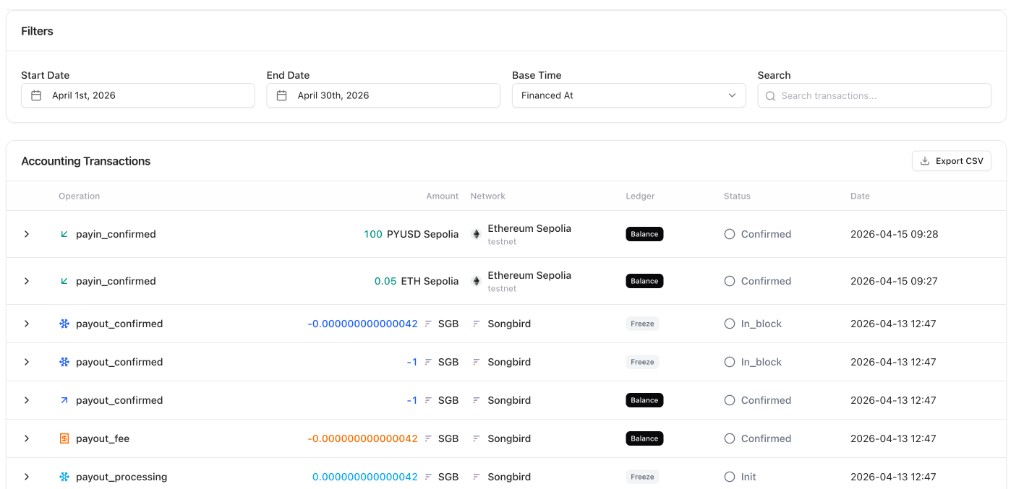
A complete, unified ledger of every financial event across all blockchains — deposits, withdrawals, fees, and internal reserve movements — in a single timeline. No need to reconcile data from multiple block explorers or chain-specific tools.
Every transaction is enriched with:
- Human-readable amounts — formatted values with asset name and decimals, alongside raw blockchain amounts
- Asset metadata — name, type (native/token), network, contract address
- Ledger classification —
Balance(confirmed on-chain) orFreeze(reserved for pending transactions) - Dual timestamps — platform timestamp (when recorded) and block timestamp (when finalized on-chain)
- Blockchain reference — on-chain transaction hash for independent verification
Double-Entry Ledger
The platform uses a double-entry approach:
- When a withdrawal is created, the amount moves from
BalancetoFreeze(reserved) - When confirmed on-chain, the amount is debited from
Freeze - Network fees are recorded as separate line items
This ensures balances are never overstated and pending transactions are immediately reflected in the available balance — critical for operations teams processing high volumes of withdrawals.
Who Uses This
Finance & Treasury Teams
- Consolidated multi-chain view — 60+ blockchains in one dashboard, no chain-specific tools
- Monthly close — historical statements for any period, exportable as CSV
- ERP integration — structured data ready for import into existing accounting systems
- Fee tracking — network fees isolated as separate entries for accurate cost allocation
- Vault-level reporting — separate statements per vault for fund segregation (client funds vs. operating funds vs. treasury)
Compliance & Audit
- Complete audit trail — every deposit, withdrawal, and fee with blockchain hash and timestamps
- Point-in-time proof — demonstrate what was held on any date for regulatory inquiries or auditor requests
- Exportable records — CSV export for auditors, structured API data for automated compliance workflows
- Retention — 5-year minimum, configurable up to 10 years
Operations
- Real-time monitoring — positions updated as transactions confirm on-chain
- Available balance — prevents overdrafts by accounting for pending outgoing transactions
- Top addresses — identify largest positions across a vault for risk management
See Also
- Key Features
- Compliance & Regulatory
- Balance Reconciliation (developer guide)
- Accounting API (API integration)